About the experiment
This experiment compares an ordinary air-filled balloon with a balloon containing water. When brought near a candle flame, the first can burst easily, while the water-filled balloon can withstand the heat for some time.
This experiment uses an open flame. It should be performed only under adult supervision. Remove flammable objects from the area and be careful around the hot candle and flame.
Experiment
- Prepare two balloons: fill one only with air, and add water to the other before inflating it with air.
- With an adult's help, light the candle.
- Carefully bring the ordinary balloon near the flame and observe the result.
- Then bring the lower part of the water-filled balloon that is directly in contact with the water near the flame.
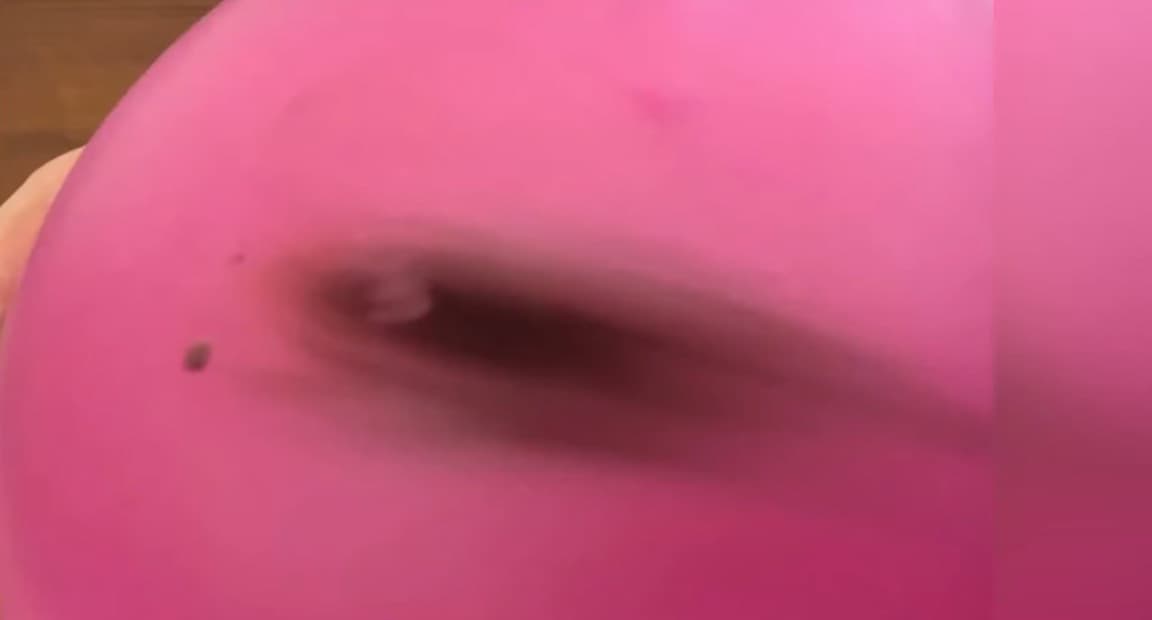
- Observe how that area gradually turns black without immediately bursting.
A water-filled balloon can still burst. Do not bring the flame near a part of the balloon that has no water behind it, and keep your face away from the balloon.
How does it work?
The rubber of an ordinary balloon heats up quickly in a candle flame. At high temperature, the rubber weakens and can no longer withstand the pressure of the air inside, causing the balloon to burst.
With a water-filled balloon, the water continuously absorbs and distributes heat from the rubber. Water has a high specific heat capacity, so it can absorb a significant amount of heat while warming relatively slowly. This keeps the rubber temperature lower for some time.
Heat absorption
where is the absorbed heat, is mass, is specific heat capacity, and is the change in temperature.
Why does the balloon turn black?
During candle combustion, especially under incomplete combustion, tiny carbon particles called soot can form. They settle on the surface of the balloon and create the black mark.
The black mark is not what protects the balloon from bursting. The main role is played by the water inside the balloon, which absorbs heat transferred from the flame.