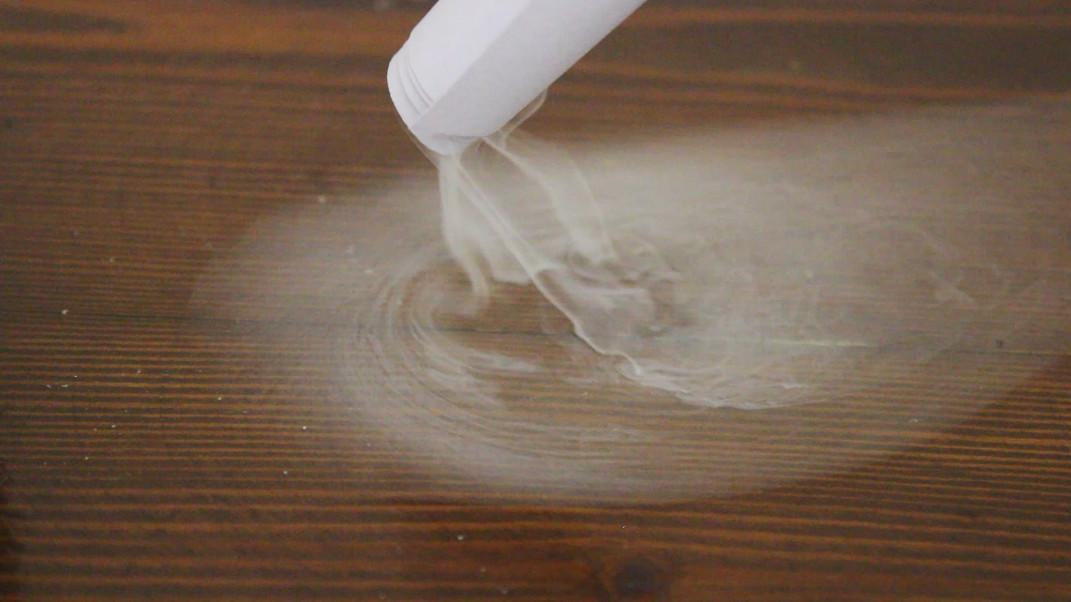
About the experiment
In this experiment, smoke produced by burning paper travels downward through a tube and spreads across a plate, creating the appearance of a “smoke waterfall.”
This experiment uses an open flame and produces smoke. Perform it only under adult supervision, outdoors or in a very well-ventilated area. Do not inhale the smoke, and keep flammable materials away.
Experiment
- Wrap paper around a pencil to form a narrow tube.
- Remove the pencil while keeping the paper tube's shape.
- Carefully attach the tube to a fork.
- Position it over a glass so that the lower opening points toward the plate.
- With an adult's help, light the upper end of the paper tube.
- Observe how smoke emerges from the lower end and spreads downward.
How does it work?
Burning paper is a chemical process that produces gases as well as tiny solid and liquid particles. We see the mixture of these particles as smoke.
Hot smoke normally rises because hot gas is less dense than the surrounding cooler air.
In this setup, the smoke cools while traveling through the paper tube. When it becomes cool enough, the smoke-laden air flow can move downward and leave through the tube's lower opening.
This creates a waterfall-like flow.
Saying “smoke is heavier than air” is not a complete explanation. The temperatures of the smoke and air, differences in density, and the flow formed inside the tube are all important here.
What can you observe?
Compare the motion of the hot smoke produced at the beginning with the motion of the cooler smoke leaving the lower part of the tube.