About the experiment
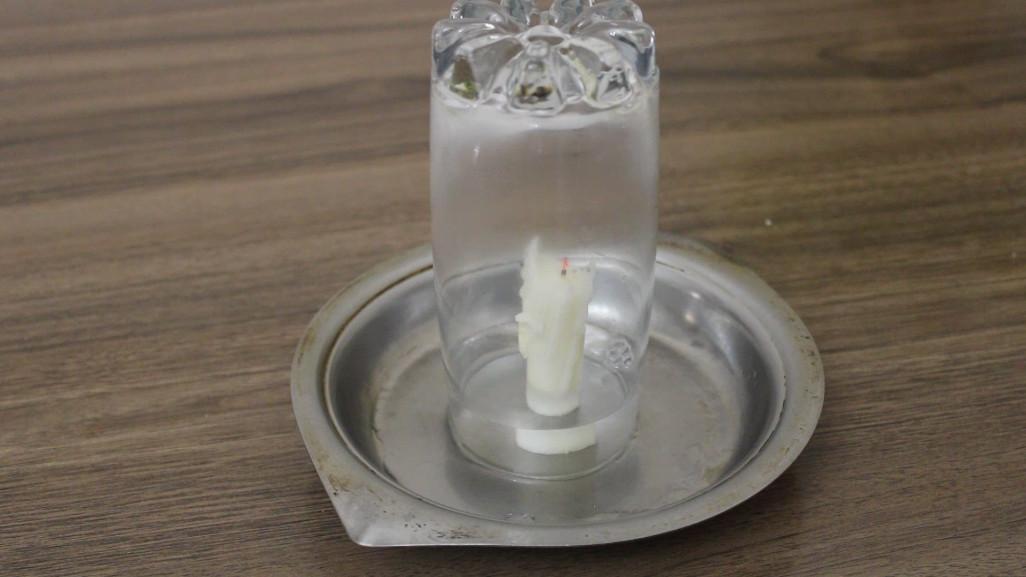
In this experiment, a burning candle is covered with a glass. After a short time, the flame goes out and some of the water on the plate rises inside the glass.
This experiment uses an open flame. Perform it only under adult supervision. Be careful with hot wax, fire, and the heated glass.
Experiment
- Secure the candle in the center of the plate.
- Pour enough water into the plate to cover the bottom.
- With an adult's help, light the candle.
- Place an inverted glass over the candle so that its rim remains in the water.
- Observe the flame and the water level.
- Wait until the candle goes out and the water begins to rise inside the glass.
How does it work?
When the glass is placed over the candle, a certain amount of air is trapped inside.
During combustion, this air warms up. At the same time, the candle consumes some oxygen and produces carbon dioxide and water vapor.
When the flame goes out, the gas inside the glass begins to cool. Some of the water vapor may also condense. As a result, the gas pressure inside the glass decreases.
At that point, the atmospheric pressure outside is greater than the pressure inside the glass, so it pushes water into the glass.
Explaining the rising water only by oxygen consumption is incomplete. Heating of the air, subsequent cooling, condensation of water vapor, and the resulting pressure difference also play important roles.
The idea of pressure
Pressure can be expressed by the following relationship:
where is pressure, is the force acting on a surface, and is the area.
In this experiment, water moves because the pressures inside and outside the glass are temporarily unequal.