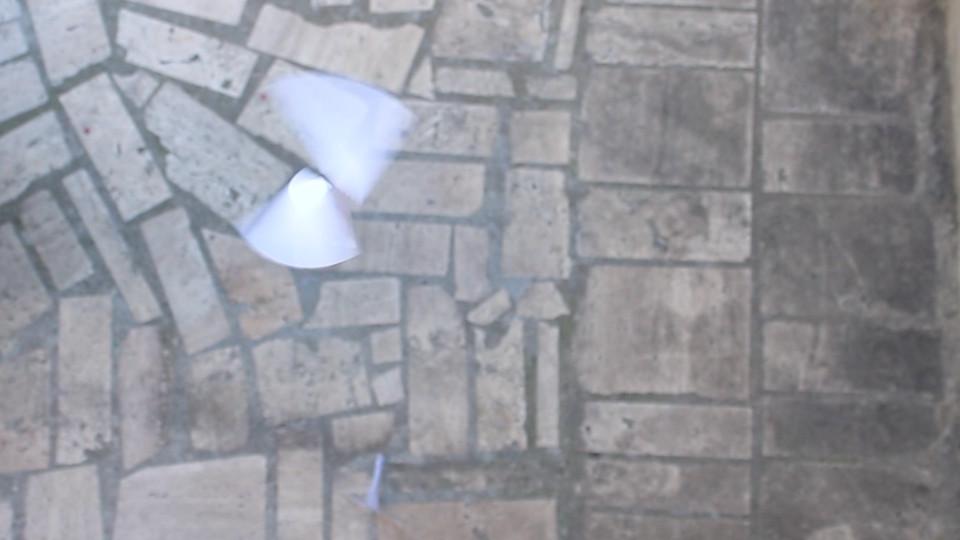
About the experiment
In this experiment, you make a simple paper helicopter that starts spinning and descends slowly when released.
Experiment
- Cut along the straight lines of the template.
- Fold sections “A” and “B” toward the center.
- Fold section “C” upward.
- Secure the folded sections with adhesive tape if necessary.
- Fold the two rotor blades outward in opposite directions.
- Hold the helicopter up high and release it.
- Observe how it spins as it descends.
Try releasing the helicopter from different heights and compare the fall time.
How does it work?
Gravity acts downward on the helicopter.
As it begins to fall, the air acts on the blades and creates air resistance. The shape of the blades and the fact that they are folded in opposite directions cause the helicopter to rotate.
Rotation increases the interaction between the blades and the air, making the descent slower and more stable.
The paper helicopter has no motor and does not rise like a real helicopter. It uses aerodynamic forces created during the fall to rotate and descend more slowly.
What can you test?
Change the blade length, folding angle, or paper thickness and compare how the rotation speed and fall time change.