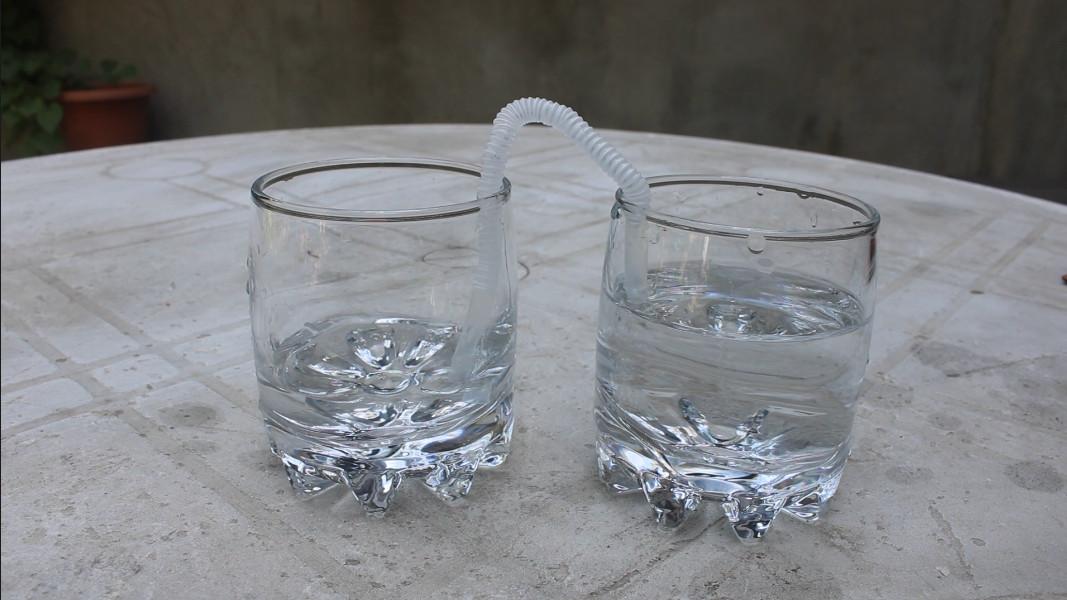
About the experiment
In this experiment, water is transferred from one glass to another without a pump, using only a straw. This phenomenon is called a siphon.
Sharp scissors are used to cut the straw. Perform that step under adult supervision.
Experiment
- Use scissors to cut the straw to the required length.
- Fill the straw completely with water, making sure as little air as possible remains inside it.
- Close one end of the straw with your finger.
- Keep the other end in the glass of water.
- Move the closed end over the empty glass so that it is lower than the initial water level.
- Release the end of the straw.
- Observe how water begins to flow into the empty glass.
How does it work?
A siphon works when there is a continuous column of water inside the straw and the outlet end is lower than the original water level.
At the outlet, gravity pulls the water downward. This motion lowers the pressure in the upper part of the straw.
At the same time, atmospheric pressure acts on the surface of the water in the original glass and helps push water into the straw.
As a result, water continues moving from the higher level to the lower level.
A siphon does not mean that water simply “rises against gravity” by itself. The overall flow is possible because the outlet ultimately lies lower and a continuous column of liquid is maintained inside the straw.
What can you test?
Change the height difference between the two glasses and observe how the water flow rate changes.
You can also gradually raise the receiving glass. When it is no longer sufficiently lower, the siphon flow will weaken or stop.