About the experiment
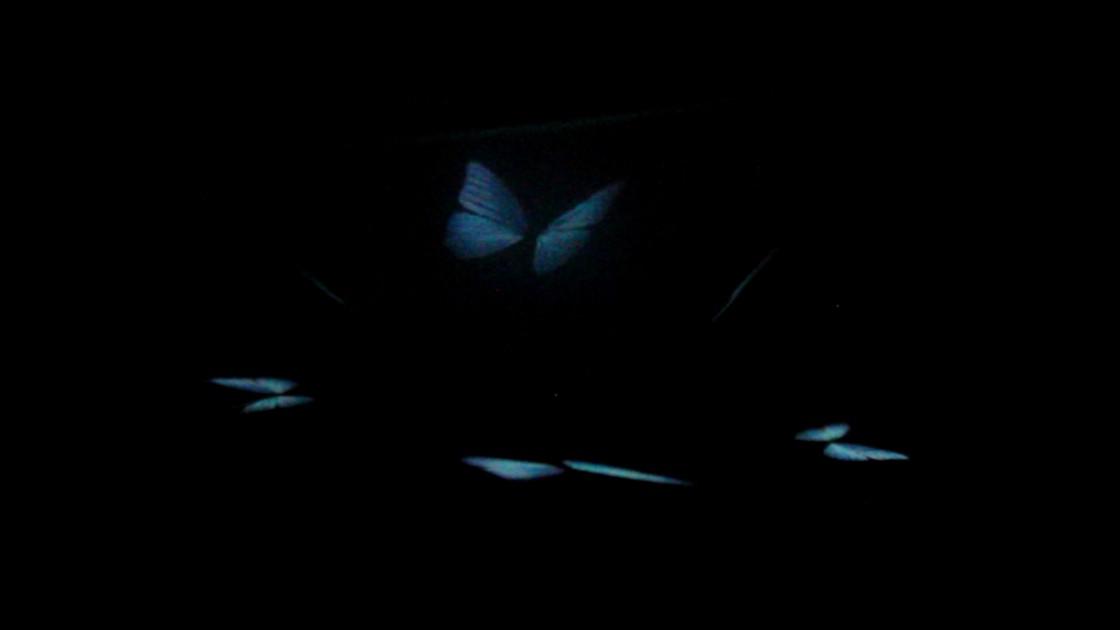
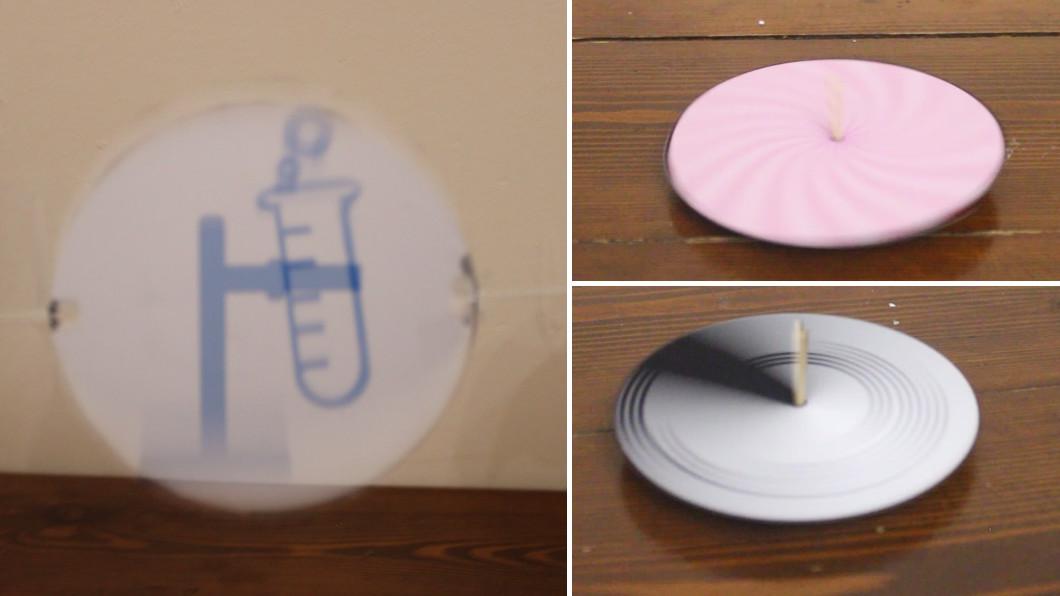
This experiment includes two different spinning optical illusions.
In the first, two images alternate rapidly on a spinning disk and can be perceived as one combined or moving image.
In the second, disks with different patterns spin on a table, creating illusions of moving lines, rings, and shapes.
Scissors, a hole punch, and a push pin are used during preparation. Make holes and use sharp tools only under adult supervision.
Experiment 1 — Spinning Animation
- Cut out the two matching circles from the template.
- If necessary, glue them onto thick paper or cardboard.
- Attach the two images to opposite sides of the disk, aligning the marked black dots.
- Use a hole punch to make holes at each marked position.
- Cut two pieces of thread, each about 30 cm long.
- Pass the threads through the holes and tie them securely.
- Spin the disk to twist the threads.
- Pull and relax the threads to make the disk spin rapidly.
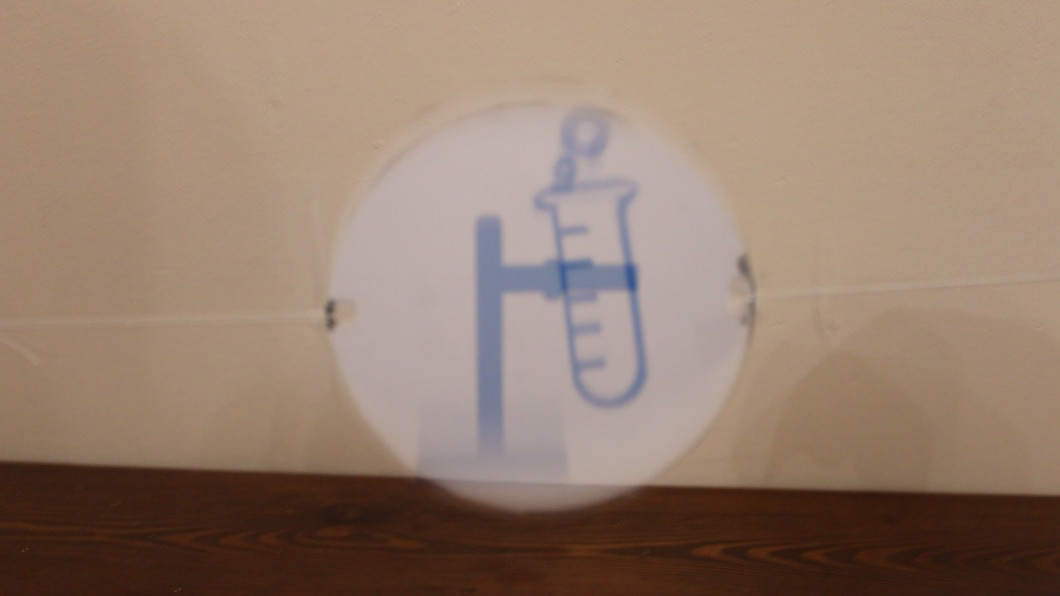
- Observe how the images on the two sides visually blend or create the impression of motion.
How does the first illusion work?
When the disk spins very quickly, the images on its two sides are presented to the eyes at very short time intervals.
Our visual system does not immediately “forget” each individual image. Rapidly alternating images can be perceived as one combined image or as continuous motion.
This principle is related to persistence of vision and, more broadly, temporal visual perception.
This does not mean that the eye simply “stores an image for a fixed amount of time.” The illusion of motion is connected to the combined visual processing performed by the eyes and brain.
Experiment 2 — Spinning Patterns
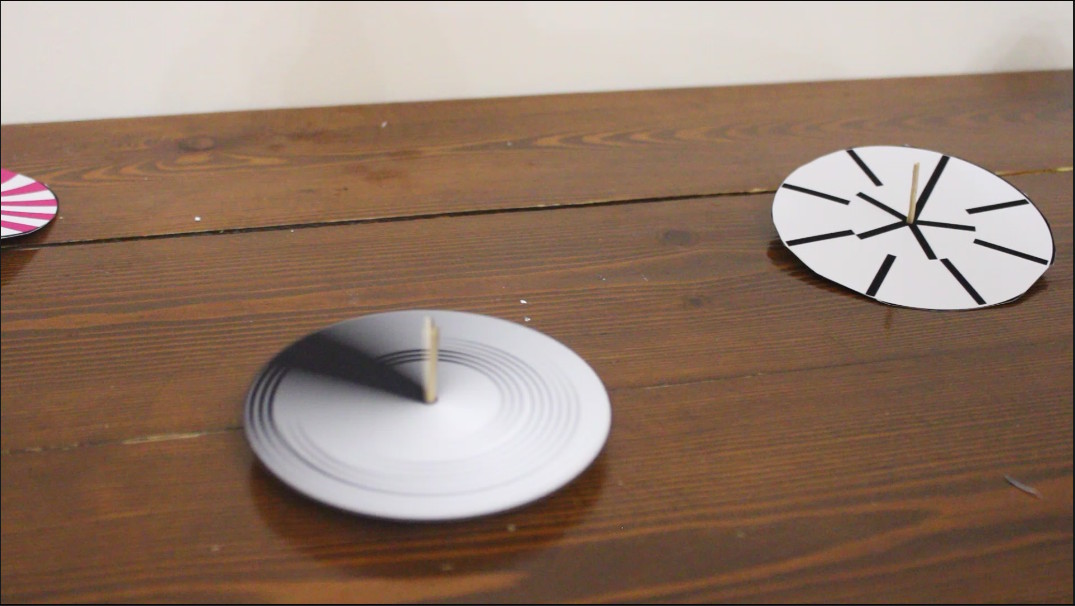
- Cut out the circle with your chosen pattern from the template.
- Carefully make a small hole exactly in the center with a push pin.
- Insert the pointed end of a toothpick through the central hole.
- Make sure the disk is as balanced as possible.
- Place it on a flat surface and spin it.
- Observe how the pattern looks while spinning.
- Repeat with the other disks and compare the results.
How does the second illusion work?
As the disk spins, its lines and colored sections change position relative to the viewer very quickly.
If these changes are fast enough, the visual system no longer perceives every line or section as a separate stationary image. Instead, new rings, moving patterns, color blends, or other forms may appear.
The appearance of the illusion depends on several factors:
- the rotation speed of the disk,
- the structure of the pattern,
- the thickness and position of the lines,
- the choice of colors.
What can you test?
Try different disks at different speeds and compare the results.
You can also observe:
- the difference between fast and slow rotation,
- black-and-white versus colored patterns,
- different lighting conditions,
- changing the direction of rotation.
If the disk vibrates or tilts to one side, check whether the center hole is truly centered and whether the disk is balanced.