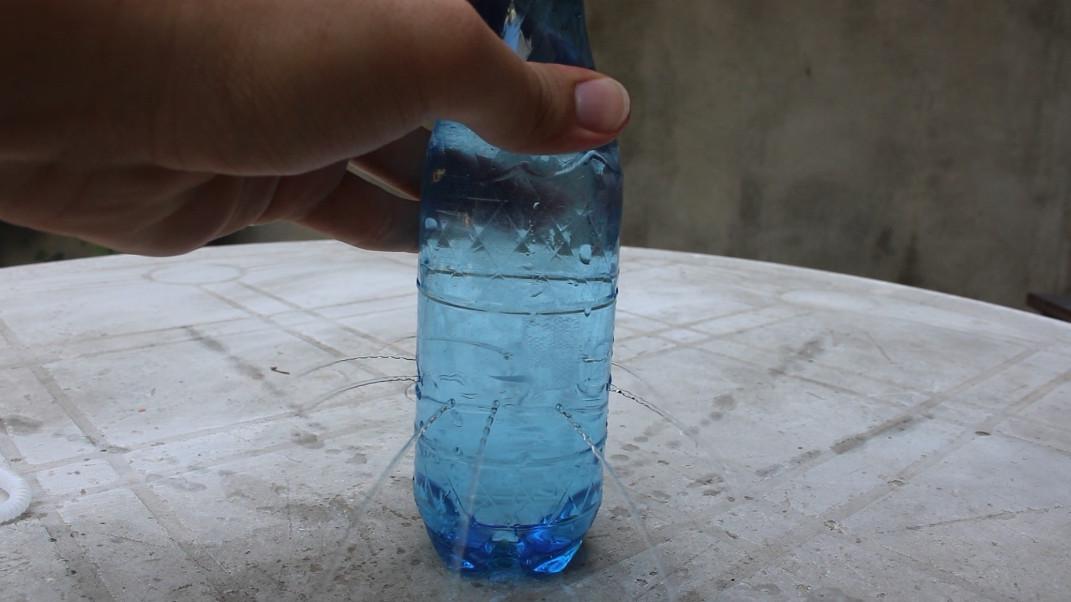
About the experiment
This experiment shows how the difference in air pressure inside and outside a bottle can affect water flowing out of it.
A needle is used to make a hole in the bottle. Perform this step only under adult supervision and with care.
Experiment
- Use a needle to make a small hole in the side of an empty plastic bottle.
- Temporarily cover the hole with adhesive tape.
- Fill the bottle with water and close the cap tightly.
- Place the bottle on a surface where spilled water will not cause a problem.
- Remove the tape and observe the hole.
- Then carefully open the bottle cap.
- Observe how the water flow changes.
How does it work?
When the bottle cap is closed, water tries to leave through the hole under the influence of gravity.
However, if water leaves without new air entering, the air pressure inside the bottle decreases. This pressure drop opposes further water flow, so the stream can become very weak or, under some conditions, nearly stop.
When the cap is opened, outside air can enter the bottle. The pressure inside can then equalize more easily with atmospheric pressure outside, allowing water to continue flowing through the hole.
Water leaves mainly because of gravity, while air pressure determines how easily air can replace the water leaving the bottle.
What can you test?
Try holes of different sizes or different amounts of water and compare how the flow rate changes.
You can also compare three states: cap closed, partially open, and fully open.