About the experiment
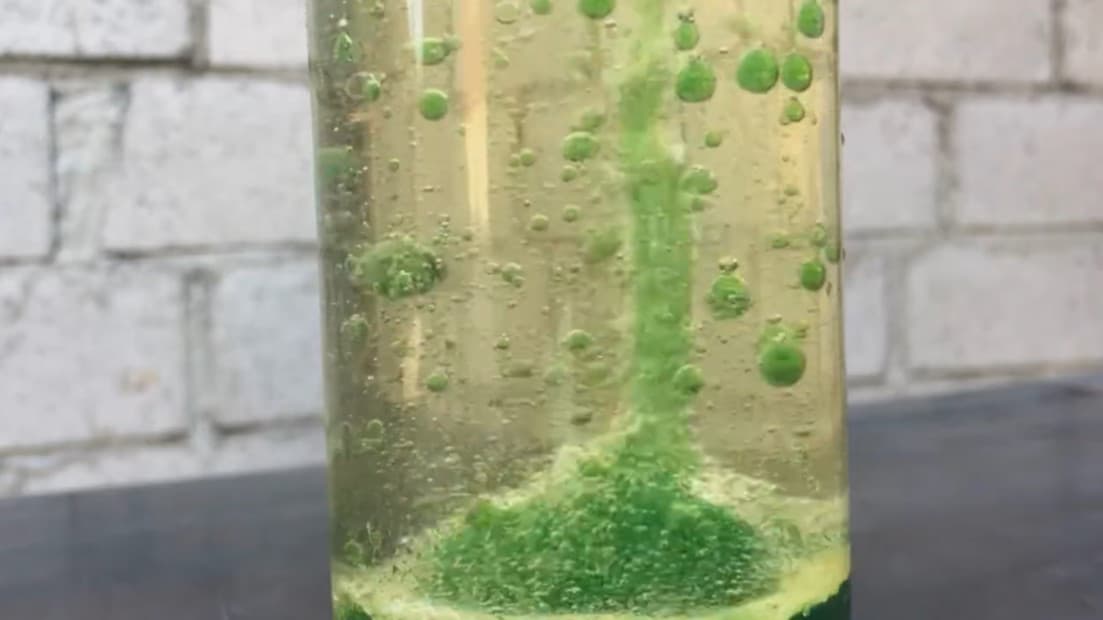
This experiment imitates the motion of a regular lava lamp without electricity or heating. Water and oil form separate layers, while gas produced by an effervescent tablet moves colored drops of water up and down.
Do not seal the bottle during the experiment. The effervescent tablet produces gas, which can increase pressure in a closed container. Do not drink the experiment mixture.
Experiment
- Pour some water into the bottle.
- Add a few drops of food coloring and mix.
- Add olive oil, leaving some empty space at the top of the bottle.
- Wait until the water and oil separate into two layers.
- Drop a piece of the effervescent tablet into the bottle.
- Observe the movement of the colored drops.
- After the movement stops, you can add another small piece.
How does it work?
Why don't water and oil mix?
Water and oil are liquids that do not mix well with each other. In addition, oil is less dense than water, so it remains above the water.
Food coloring mainly mixes with the water layer and does not spread through the oil in the same way.
Density
where is density, is mass, and is volume. Oil is less dense than water, so it stays on top.
What does the effervescent tablet do?
When the tablet reaches the water, its ingredients dissolve and react, producing carbon dioxide (CO₂).
Gas bubbles attach to drops of colored water and carry them upward through the oil. When they reach the surface, the CO₂ escapes into the air and the water drops sink again.
This repeated rising and falling creates motion resembling a lava lamp.
In a real lava lamp, motion is usually produced by heat and changes in liquid density. This experiment only imitates the appearance using CO₂ bubbles.
What can you test?
Try adding different-sized pieces of the tablet and compare the number of bubbles and the speed of movement. You can also try different food colors to create different “lava lamps.”