About the experiment
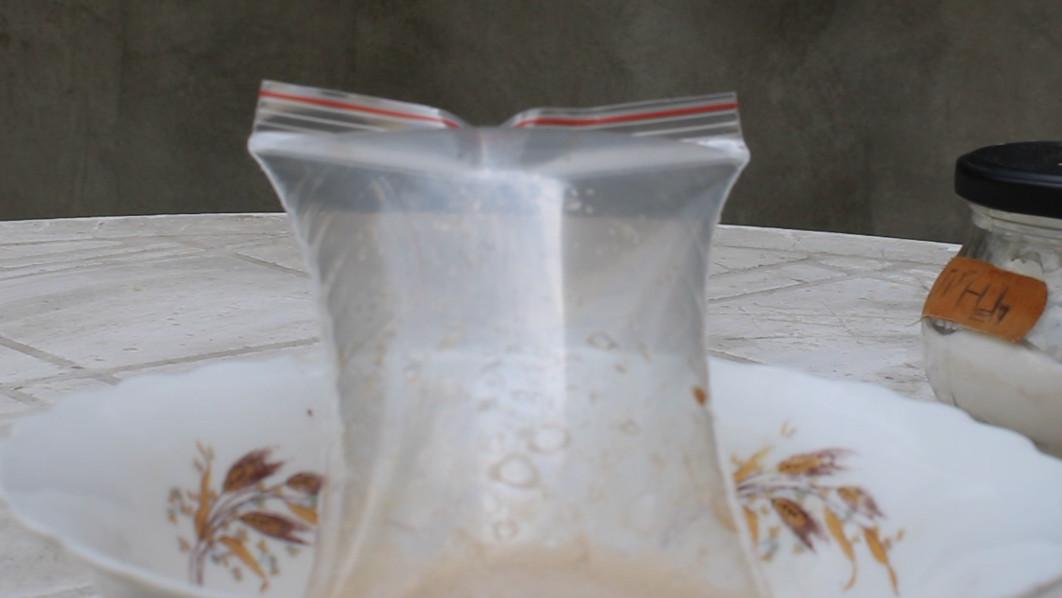
In this experiment, baking soda and vinegar react to produce carbon dioxide. Because the gas is trapped inside a sealed ZIP bag, it begins to expand the bag.
Pressure inside the sealed bag can rise quickly, and the bag can tear or burst, splashing liquid. Perform the experiment under adult supervision, with safety goggles, and inside a bowl or tray. Do not intentionally try to make the bag burst.
Experiment
- Place the ZIP bag inside a bowl or tray.
- Use a funnel to add baking soda to the bag.
- Carefully add vinegar.
- Immediately seal the ZIP closure and move your hands away from the bag.
- Observe how the bag gradually inflates.
- If it becomes excessively tight, do not approach or squeeze it.
How does it work?
Baking soda, sodium bicarbonate, reacts with the acetic acid in vinegar and produces carbon dioxide gas.
Chemical reaction
The released accumulates inside the sealed bag.
As the number of gas particles increases, they collide with the walls of the bag more frequently. This raises the pressure inside, causing the flexible bag to expand.
The inflation of the bag is a physical effect, while the production of gas is the result of a chemical reaction. This is why the experiment combines both chemistry and physics.
The idea of pressure
Gas pressure can be related to particle motion and the volume of the container. The key observation in this experiment is that producing new gas in an enclosed space can increase pressure.
What can you observe?
Watch how the bag inflates rapidly at the beginning of the reaction and then changes more slowly as the reaction becomes less active.