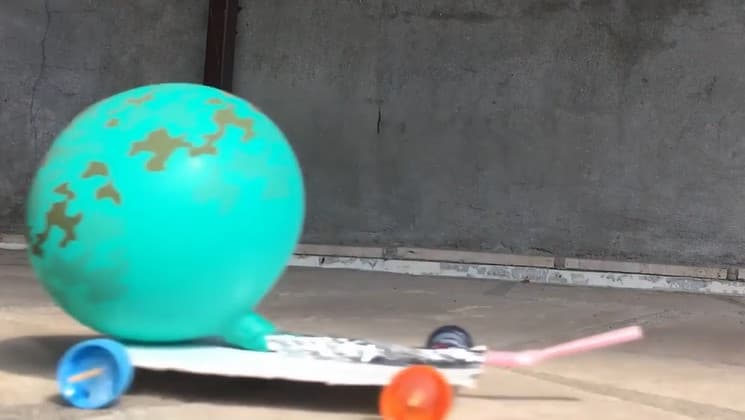
About the experiment
In this experiment, you will build a small car that works without a motor. Air stored inside a balloon escapes through a straw and makes the car move.
Scissors, a screwdriver, and hot glue are used while building the car. Cutting, making holes, and using a hot glue gun should be done under adult supervision.
Preparation
- Cut a straw to about 15 cm long.
- Cut about 11 cm of adhesive tape and use it to attach the straw to the cardboard.
- Connect the balloon to a second straw so that air escaping from the balloon passes through the straw.
- Seal the connection tightly with tape so air cannot leak from the sides.
- Attach the balloon-and-straw assembly to the cardboard base.
- Carefully make holes in the centers of four bottle caps.
- Cut two wooden skewers to the required length to make the wheel axles.
- Pass the wooden skewers through the straws attached under the car.
- Place the bottle-cap wheels on both ends of each axle.
- If necessary, secure the wheels with hot glue while making sure the axles can still rotate freely.
Experiment
- Inflate the balloon through the straw.
- Place the car on a flat surface.
- Release the air outlet.
- Observe the car's motion.
How does it work?
When the balloon is inflated, its elastic walls compress the air inside. When released, the air rushes out through the straw at high speed.
This demonstrates Newton's third law: when the car pushes air backward, the escaping air exerts a force on the car in the opposite direction, causing the car to move forward.
Friction also affects the car's motion. If the wheels or axles are difficult to rotate, friction can significantly slow the car down.
The balloon does not move the car forward simply because there is “air inside it.” Motion occurs when air is expelled and produces an oppositely directed force on the car.
Newton's third law
where the forces are equal in magnitude and opposite in direction. The balloon pushes air backward, while the air exerts an opposite force on the car, moving it forward.
What can you test?
Try changing the balloon size, the mass of the car, or the wheel size and measure the distance traveled. You can also compare different surfaces to investigate how friction affects the car's motion.