About the experiment
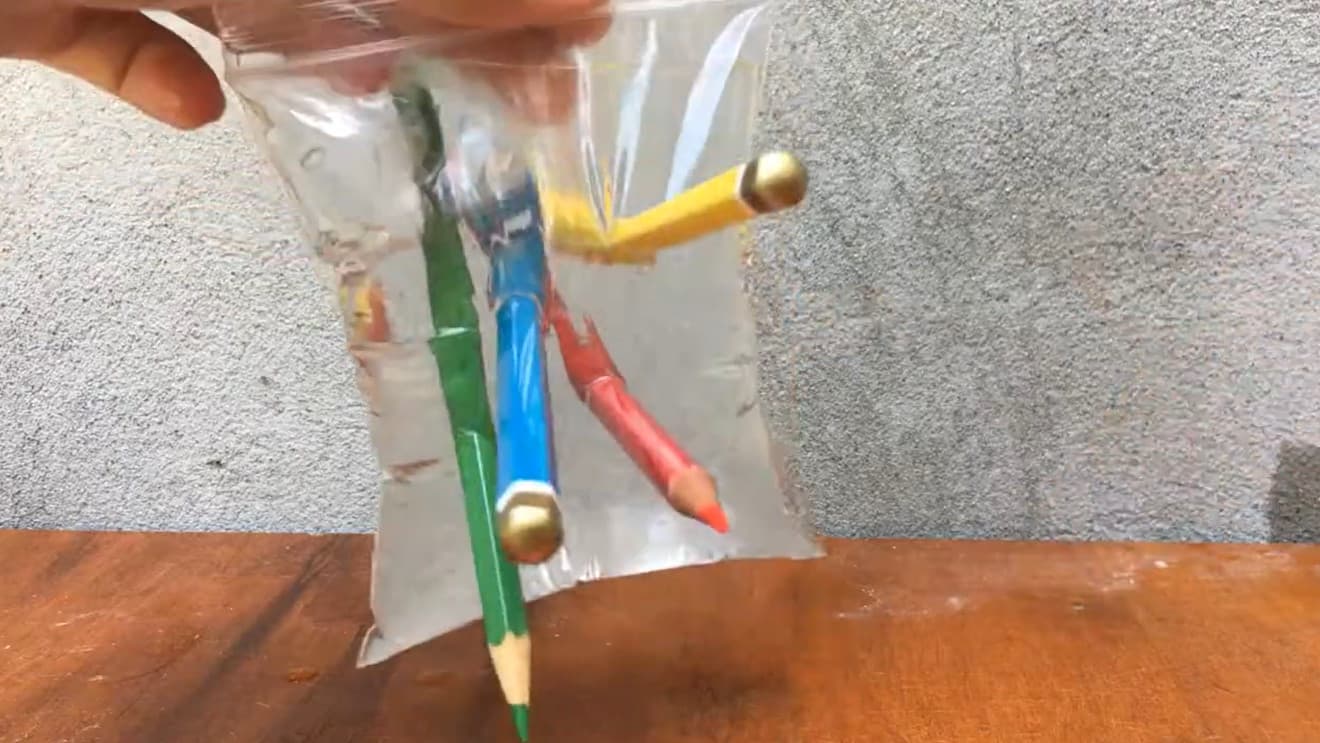
In this experiment, sharpened pencils pass through both sides of a water-filled plastic bag, yet the water does not immediately pour freely from the holes.
Experiment
- Partially fill a ZIP-seal bag with water.
- Seal the bag tightly.
- Hold the bag with one hand.
- Carefully push a sharpened pencil through one side of the bag and out the other in one continuous motion.
- Repeat with several other pencils.
- Observe what happens around the pencils.
Do not remove the pencils during the experiment. Once they are removed, water will begin to leak through the holes that were made.
How does it work?
Many ZIP bags are made of polyethylene, a material composed of long polymer molecular chains.
When a sharpened pencil passes through the bag, it pushes these chains aside rather than tearing the material widely. The plastic presses around the surface of the pencil and seals the opening fairly well.
This allows the pencil to remain through the bag with relatively little water leakage.
The bag does not become completely watertight. The result depends on the bag material, thickness, pencil shape, and size of the hole.
What can you test?
Try increasing the number of pencils or compare plastic bags of different thicknesses. Observe which setup produces more water leakage.