About the experiment
This colorful experiment lets you observe how dye from the outer coating of M&M's dissolves in a liquid and gradually spreads, creating interesting patterns.
The first version uses water, while the second uses ethyl alcohol so the behavior of the dyes can be compared in different solvents.
Experiment 1 — Water
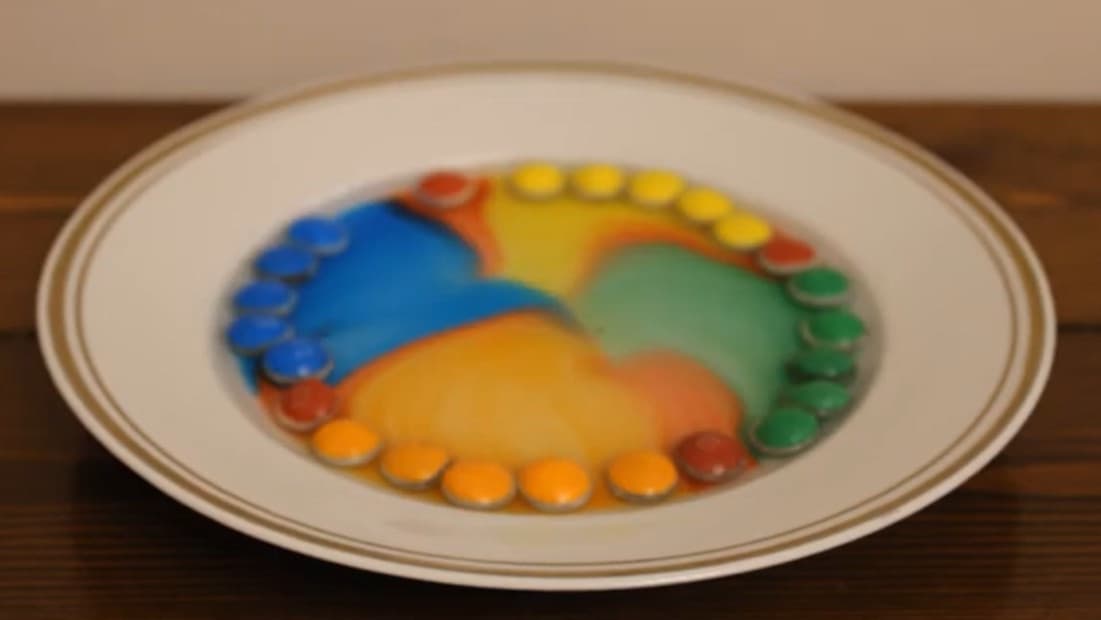
- Arrange the M&M's in a circle near the edge of a plate.
- Carefully pour enough water into the center of the plate for it to reach the candies.
- Do not move the plate.
- Observe how the colors begin to spread toward the center.
Try arranging the M&M's in different color sequences and compare the patterns you get.
How does it work?
When water reaches the colored outer coating of an M&M's candy, its water-soluble components begin to dissolve.
The dissolved dye particles then spread through the water. This process is related to diffusion: the movement of particles from regions of higher concentration toward regions of lower concentration.
Because the solutions of different colors initially spread outward from their own candies, visible colored regions and patterns form.
The main processes observed here are dissolution and diffusion. This is not chromatography because the dyes are not being separated through mobile and stationary phases.
Experiment 2 — Ethyl alcohol
Ethyl alcohol is flammable. Perform this version only under adult supervision and keep it away from flames, sparks, and heat sources. Do not eat the M&M's used in the experiment afterward.
- Arrange M&M's again on a clean plate.
- Carefully add ethyl alcohol instead of water.
- Do not move the plate.
- Observe the spread of the dyes and compare it with the water experiment.
Why is the result different?
The solubility of dyes and other coating components depends on the solvent. Water and ethyl alcohol have different properties, so components of the M&M's coating can dissolve and spread through them at different rates.
If the colors spread more slowly in ethyl alcohol, you can compare this with the water result to show how the choice of solvent can change how substances dissolve.
What can you test?
You can change the water temperature, the arrangement of M&M's colors, or the amount of liquid and compare the resulting patterns and the rate at which the colors spread.