About the experiment
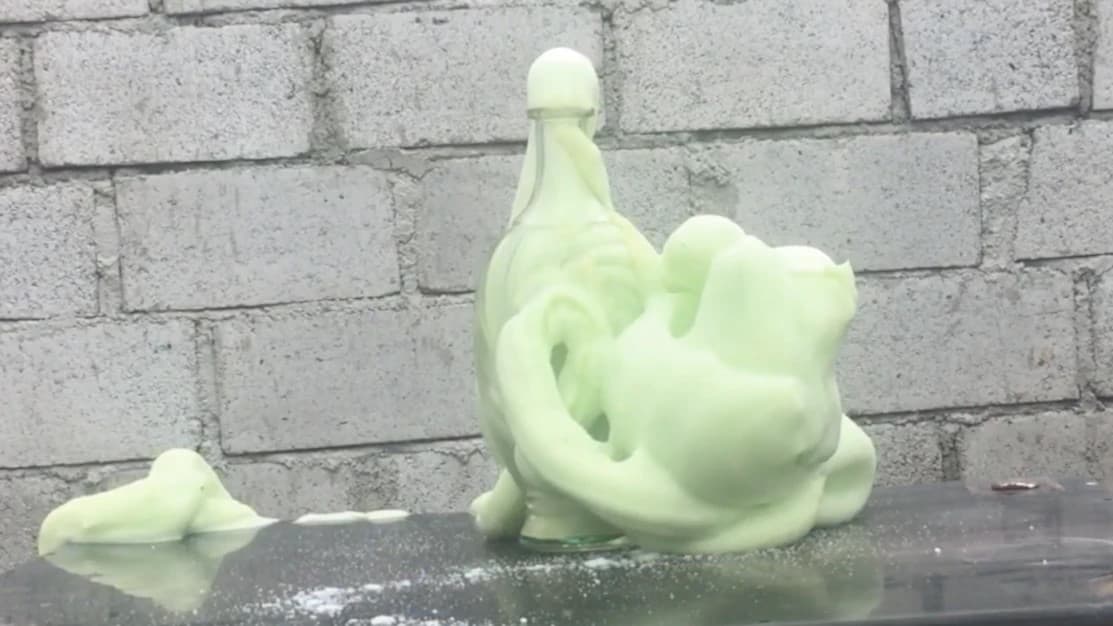
“Elephant Toothpaste” is a chemistry experiment that demonstrates the rapid decomposition of hydrogen peroxide. Oxygen released during the reaction becomes trapped in the dishwashing liquid, producing a large amount of foam.
This version uses 10% hydrogen peroxide. The experiment is not intended to be performed without supervision. Wear safety goggles and gloves, and do not touch the resulting foam.
Experiment 1 — Catalase
- Place the bottle in a tray or container.
- Pour the hydrogen peroxide into the bottle.
- Add dishwashing liquid.
- Add food coloring and mix carefully.
- Pour warm water into a separate cup.
- Add yeast to the water and mix.
- Pour the yeast mixture into the bottle and move away from the immediate area around it.
- Observe the foam that forms.
Experiment 2 — Potassium iodide
The potassium iodide version can proceed very quickly and vigorously. 10% hydrogen peroxide can harm skin and eyes, and the reaction mixture and foam can become significantly hot. Perform the experiment only with appropriate supervision, safety goggles, and gloves.
- Place the bottle in a tray or container.
- Pour the hydrogen peroxide into the bottle.
- Add dishwashing liquid.
- Add food coloring and mix carefully.
- Add the potassium iodide all at once.
- Observe the foam that forms.
What is happening?
Experiment 1 — Catalase
Hydrogen peroxide decomposes into water and oxygen. The catalase enzyme in yeast speeds up this process.
The released oxygen becomes trapped in bubbles in the dishwashing liquid. This is why a small amount of liquid produces a large amount of foam.
The reaction is also exothermic, meaning some energy is released as heat. As a result, the bottle and foam can become warm.
Chemical reaction
Catalase speeds up the decomposition of hydrogen peroxide into water and oxygen.
Experiment 2 — Potassium iodide
Iodide ions in potassium iodide also act as a catalyst, accelerating the decomposition of hydrogen peroxide. The catalyst participates in intermediate steps but is not consumed in the overall reaction.
The overall reaction remains the same:
Safety
- Do not perform the experiment without a responsible adult or appropriate supervision.
- Wear safety goggles and gloves.
- Avoid contact of hydrogen peroxide with the skin and especially the eyes.
- Do not touch or taste the resulting foam.
- Perform the experiment on a surface that is easy to clean.